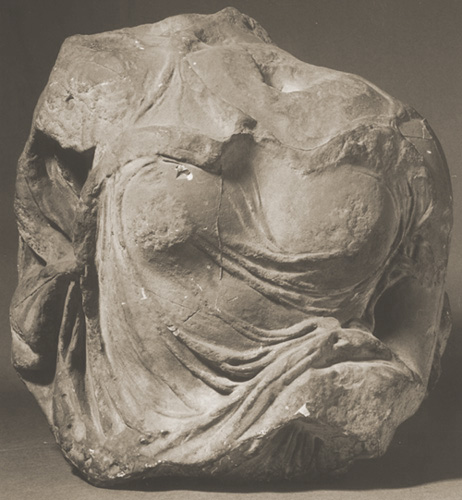
Torso of a woman.
Commentary Prepared by Dr. Julia Lenaghan, Ashmolean Museum
A 110
Fragment of draped female from the Argive Heraion. Athens
Under life-size torso of a running female. From the pedimental decoration of the Argive Heraion, ca. 400 BC.
Marble (Parian)
Pedimental Figure
40 cm
From the Argive Heraion. Found in the neighboring village of Chonika.
Greece, Athens, National Museum, 1578
Ca. 400 BC
Preservation: The piece is broken through the waist and through the neck. At the neck surface is a dowel hole, which either indicates that the head was originally worked separately or was later repaired. The right arm has broken off. There is a hole at the right shoulder, perhaps for an original bronze attachment or part of an ancient repair. It is too small for the addition of the entire arm. The left arm and many of the thicker folds are heavily abraded. The fragment joins another fragment from the Heraion, Athens National Museum 4035, which shows the figure’s thighs.
Description:The under life-size fragment depicts the torso of a young woman who wears a thin garment that blows around the body. The material is fine and the folds are artfully placed in curving patterns.
The sleeveless garment is fastened at both shoulders by thin straps that are not pulled taut. The neckline is loose and blown back up towards the shoulders. The material on the body is transparent and clings revealingly to the body. The folds that rise from the flat expanse are large shallow curves. These curves play around the breasts. The material at the back and sides of the body seems heavier and the folds are deeper, perhaps belonging to a second heavier garment. The left arm, which is bent at a 90 degree angle with the forearm across the body, pushes up a portion of the heavier material. This causes a bundle of material as well as the fold patterns to be swept upward at the left waist. The back of the figure is only schematically worked.
Discussion:This female torso in active motion with blowing and billowing drapery comes from the sculpted decoration of the second temple of the Argive Heraion. The Argive Heraion was a Sanctuary dedicated to the goddess Hera on the eastern limits of the Argive plain, approximately five kilometers from Mycenae and ten kilometers from Argos. The second temple is usually dated on architectural grounds around 400 BC. The sanctuary and the temple are more fully discussed under cat. no. A 109.
This particular fragment was found in a neighboring town and was displayed in the local museum already in 1880. It, however, stylistically and technically resembles other sculpture found at the temple. Moreover, it joins a fragment depicting the thighs that was found at the Heraion. The size, workmanship, and motion of the fragment indicate that it belonged in the pediment; although it has sometimes been said in the past to have been an acroterion, this is unlikely. The fragment demonstrates two characteristics that are common to marble sculpture around 400 BC; these are the active motion which creates sweeping swirling folds and the appearance of the body forms through the material. These traits are visible in the figures from the metopes and in the reliefs at Bassae (cf. cat. no. A 106), the so-called “Sandal-Binder” from the balustrade of the Nike Temple on the Acropolis (cat. no. A 104), and in the “Nereids” of the Nereid monument (cat. nos. A 116-117).
Julia Lenaghan
Bibliography:C. Waldstein,
The Argive Heraion I (Boston 1902) 191-192, pl. 37
brief descriptive catalogue-like entryF. Eichler,
"Die Skulpturen des Heraions bei Argos" (OJh 19/20 1919) 23-24, no.2, 122, fig. 13
discussion of piece with good note on original find locationS. Karouzou,
National Archaeological Museum. Collection of Sculpture (Athens 1968) 59
pithy out of date museum catalogue entryI. Trianti,
"O glyptos diakosmos tou vaou sto Mazi tes Eleias" Archaische und klassiche griechische Plastik II (Mainz 1986) 164, pl. 144.3-4
note on the figure and photographs of fragment with joining legsB. S. Ridgway,
Fourth-Century Styles in Greek Sculpture (London 1997) 25-30
thorough discussion of temple, with latest bibliography for the joining of this fragment with no. 4035