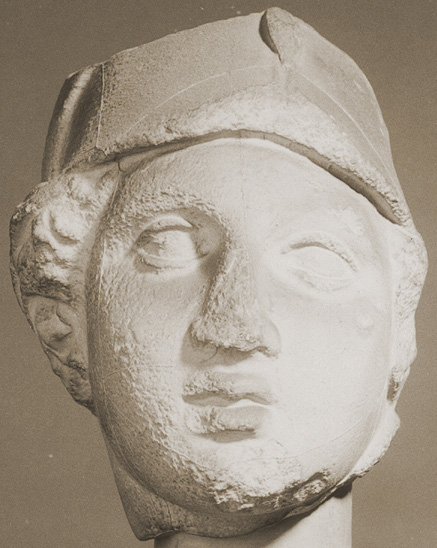
Head of a warrior.
Commentary Prepared by Dr. Julia Lenaghan, Ashmolean Museum
A 109
Head of warrior from Argive Heraion. Athens
Under life-size head of a helmeted warrior who looks up and to his left. From the pedimental decoration of the second temple of the Argive Heraion, ca. 400 BC.
Marble (Parian)
Pedimental Figure
20 cm
From the Argive Heraion. Found near the northwest corner of the second temple in 1892.
Greece, Athens, National Museum, 1564
Ca. 400 BC
Preservation: The head has broken through the neck. It is broken also at the back, through the helmet. Across the top of the helmet is a rough surface, perhaps indicating where the piece was fitted under an architectural element. The back left of this surface is, however, broken. The hair around the left ear, the nose –especially its right side, the lips, the chin, the rim of the helmet, and the central portion of the left eyebrow are abraded.
Description:The under life-size head depicts a young person wearing a domed Corinthian helmet. The right side of the face faced the viewer; the left ear and hair are not fully worked. The head was also intended to be seen from below.
The face is a small smooth oval. Only a section of the brow is visible since the front of the helmet falls across it. The eyebrows form low arching ridges. The eyes are marked by thick projecting eyelids, both upper and lower. The surface of the eyeballs is flat. Below the lower eyelids, the deepening of the eye sockets is indicated. The nose is short and has no indentation at the bridge. The mouth is small from side to side and open. The lips are projecting curvaceous bands. Under the projection of the lower lip, the chin blends harmoniously into the cheeks.
The hair of the figure is visible around the temples and above and behind the ears. It is brushed backwards, covering the top of the ear. It is thick and stands well away from the face. The helmet, which is pushed back to reveal the face, has a domed upper portion. The lower part of the raised spit-like area of the nose guard is preserved. Its lower edge, across the brow, is undercut; this accentuates the separation of head and brow.
Discussion:The Argive Heraion was a Sanctuary dedicated to the goddess Hera on the eastern limits of the Argive plain, approximately five kilometers from Mycenae and ten kilometers from Argos. Established well before the Archaic period, the sanctuary featured a seventh century temple for Hera which, according to Thucydides (4.133) burned to the ground in 423 BC. A second temple, possibly planned even before the fire, was built on a different location. Numerous sculpture fragments from the decoration of the second temple have been found. Most of the fragments were discovered either in the excavations conducted by Rhangalis and Bursian in 1854 or in the excavations undertaken by the American School of Athens in 1892-1895. A systematic and modern publication of the fragments is still lacking; currently the best description remains that of Eichler.
Pausanias (2.17.3-5) provides us with several inconclusive details about the second temple in the sanctuary. According to Pausanias, its architect was an Argive named Eupolemus; the chryselephantine cult image was made by Polykleitos; a chryselephantine statue of Hebe, made by Naukydes, stood next to it; and finally, sculpted “above the columns” were the birth of Zeus and a gigantomachy, and the battle at Troy and the capture of Ilium. Since the extant architectural details of the temple suggest a date around 400 BC (after the conflagaration of the first temple) and it is unlikely that a cult statue would have been made before the temple was finished, it is improbable that Pausanias is referring to the great Polykleitos who worked in the middle of the fifth century. It is more likely that the Polykleitos and Naukydes, to whom he refers, belonged to a second generation of pupils of the famous Polykleitos. Pausanias’ remarks about the themes of the sculpture above the columns have been interpreted to mean that the pediment and metopes on the east side of the temple showed respectively the birth of Zeus and the gigantomachy. No sculptural fragments, however, can be assigned securely to the birth of Zeus and only a couple of metope fragments seems to show any part of the gigantomachy. The west metopes are thought to have shown the Trojan war against the amazons an the west pediment the Ilioupersis. This is because many fragments belonging to the metopes show amazons, and because two female idols of the type grasped desperately by Cassandra or Helen at the capture of Ilium have been found and one of these may belong to the west pediment.
The head of the helmeted male, Athens NM 1564, is about four-fifths life-size; it probably belonged to a figure of about 1.5 m. It is clearly larger than the heads from the metopes and has, therefore, been assigned to the pediment. Another fragment, Athens NM 1576, showing a raised left shoulder and portion of chest, may belong to the same figure. The head type is not extraordinary. A similar and contemporary helmeted male figure, who drives and look upwards, is among the fragments from the pediments of the Temple of Athena at Mazi.
J. Lenaghan
Bibliography:C. Waldstein,
The Argive Heraion I (Boston 1902) 183-184, pl. 33.1-2
brief descriptive catalogue-like entryF. Eichler,
"Die Skulpturen des Heraions bei Argos" (OJh 19/20 1919) 41-43
brief discussion of fragmentB. S. Ridgway,
Fourth-Century Styles in Greek Sculpture (London 1997) 25-30
thorough discussion of Heraion with latest bibliographyM. F. Billot,
"Recherches archéologiques récentes a l’ Héraion d’Argos" Héra: Images, espaces, cultes (Naples 1997) 39-42
full summary of research on temple and sculptureC. Rolley,
La sculpture grecque II. La période classique (Paris 1999) 170-171
brief discussion of Heraion with bibliography