Commentary Prepared by Dr. Julia Lenaghan, Ashmolean Museum
A 106
Amazonomachy (Bassae, Temple of Apollo, Frieze). London.
Marble
Frieze
H: ca. 64 cm; W: 135 cm
From Bassae. First discovered by Carl Haller and Charles Cockerell in 1811, the frieze slabs were excavated in 1812 and subsequently sold to the British Museum.
United Kingdom, London, British Museum, 534
High Classical, ca. 425-400 Bc
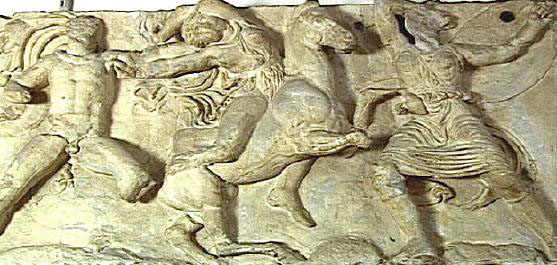
Preservation:The Greek’s lower right arm, right foot and left leg from below the knee are missing, his face is completely abraded. Both hands and the right foot of the mounted Amazon, and the right foreleg of the horse have broken off, her chin is chipped. The face and right hand of the Amazon on the right have broken off, the tip of her left foot is missing.
Description:The slab depicts three figures engaged in battle. To the left a man, nude except for a billowing cloak fastened around his neck, strides forward and with his left hand grabs the hair of a female figure in the centre. A sword must have been held in his missing left hand. The female figure is mounted on a horse, and dressed in a short chiton that leaves her right breast exposed. She reaches backwards to the man with both her arms, trying to loosen his grip, and is about to fall off the horse. Approaching her from the right is a second female figure wearing a short chiton and high boots. She holds a shield in her raised left arm, while her right arm touches her head, that was turned backwards further to the right.
Discussion:The Temple of Apollo Epikourios, situated between the villages of Bassae and Phigalia in the mountains of Arcadia in the central Peloponnese, was built in the last quarter of the fifth century BC. Its architect according to Pausanias was Iktinos, the man who had designed the Parthenon. The Bassae temple was most innovative in the particular focus on its interior space: Its cella was surrounded by buttressed Ionic columns, and a Corinthian column, possibly the first of its kind, separated cella and adyton. The special character of this inner space is further emphasized by the existence of a continuous sculptured Ionic frieze running along the inside of the cella walls, a novum in Greek temple architecture.
The frieze depicted the familiar scenes of an amazonomachy and a centauromachy. All 23 slabs of the frieze are preserved, but because they were not found in situ the exact order and position of the slabs remains in many cases unclear. Furthermore, the amazonomachy takes up more space than the centauromachy, so that an even distribution of the two narratives along the cella walls is not possible. To circumvent this problem, it has recently been proposed (by B. Madigan) that the amazonomachy itself shows two distinct subjects: a Trojan and a Heraclean episode. Some scholars have also argued that several changes in the design of the temple caused similar modifications in the frieze and a re-arrangement of the slabs, a view opposed in the latest full study of the temple.
According to this theory, the frieze starts in the northwest corner of the cella (immediately to the right of the entrance as one enters the temple) with four slabs depicting an Amazon attack on the Greeks before Troy. This is immediately followed by a different story, a battle between the Amazons and Greeks led by Heracles (represented in the slabs on display in the Cast Gallery), that extended from the middle of the west wall over the south side, and to the first slab on the east wall.
The Bassae frieze is carved in high relief with the figures close together, usually not overlapping the corners of a slab. The relief ground is filled with billowing drapery. Bodies often appear somewhat stocky, and actions are direct, involving pairs of fighters rather than larger groups.
This slab, now assigned to the west wall of the cella, shows a Greek unhorsing an Amazon, while another Amazon defends herself against a charge from further to the right.
Bibliography:A.H. Smith,
A Catalogue of Sculpture in the Department of Greek and Roman Antiquities, British Museum III (London 1904) 284-285 no. 534
Catalogue entry with basic information.H. Knell,
Mythos und Polis. Bildprogramme griechischer Bauskulptur (Darmstadt 1990) 150-159
Good summary and bibliography of recent research on the frieze.B. Madigan,
The Sculpture [= F. A. Cooper (ed.), The Temple of Apollo Bassitas, vol. II] (Princeton, N. J. 1993) esp. 73-78 pl. 46
The most recent study on the frieze, based on new research on the architecture and order of the frieze slabs. Good summary of previous theories and extensive bibliography.