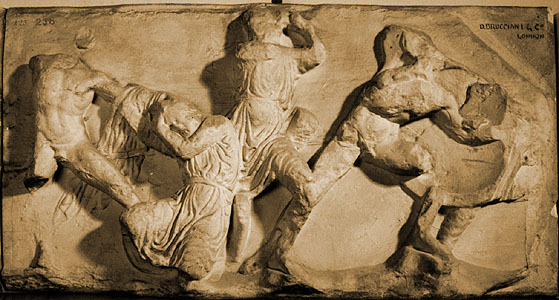
Cast Gallery catalogue number: A102b
Greeks and Persians fighting.
This part of the frieze is contiguous with A102a.
- Plaster cast: Height: 45cm.
- Copy of part of a marble frieze.
- The frieze:
- is from the west side of the Temple of Athena Nike at Athens.
- was made in about 420 BC.
- was brought from Athens to London in the early 1800s.
- is now in London, British Museum.
Detailed Record
Commentary Prepared by Dr. Julia Lenaghan, Ashmolean Museum
A 102 B
Battle between Greeks and Persians (Temple of Athena Nike, South Frieze). London.
Marble (Pentelic)
Frieze
H: ca. 45 cm; W (max.): 82 cm
South frieze, block o (right half). From the Acropolis at Athens. The slab had been reused in a Turkish fortification wall and was taken away by Lord Elgin in 1802. It was later given to the British Museum in London.
United Kingdom, London, British Museum, 423
High Classical, ca. 430-420 BC
Preservation:The entire surface is heavily worn and abraded, all figures are missing limbs. The right corner of the slab with parts of the second Greek warrior and most of a Persian is missing.
Description:The relief shows four figures and traces of a fifth. To the left is a nude man, depicted frontally, his legs wide apart. With his left he pulls the hair of a bearded man in oriental dress who kneels next to him, a quiver strapped to his side. The attacker’s right arm was raised, a mantle is draped over his left. The kneeling man tries to remove his opponent’s arm with both hands. Further to the right is another oriental, also with a quiver, moving away to the right. Both his arms are raised and may have held an axe or similar weapon. He is followed by a nude fighter advancing forward, armed with a round hoplite shield and a helmet with long crest. The leg of a further figure in oriental costume is visible immediately to the right.
Discussion:The rapid advance of the Greeks continues on this section of the frieze. A nude warrior in a wide, heroic pose is about to deal the final blow to a Persian kneeling in front of him who is defended by one of his comrades. Another Greek has already moved past that group and charges further.
For the south frieze cf. A 102a, for the temple in general see A 101a.
Bibliography:A.H. Smith,
A Catalogue of Sculpture in the Department of Greek and Roman Antiquities, British Museum III (London 1904) 242-245
Catalogue entry with basic information.C. Blümel,
"Der Fries des Tempels der Athena Nike in der attischen Kunst des fünften Jahrhunderts vor Christus" (JdI 65/66 1950) 135-165
Detailed description of the frieze.E. B. Harrison,
"The South Frieze of the Nike Temple and the Marathon Painting in the Painted Stoa" (AJA 76 1972) 353-378 pls. 73-78
Points out similarities between the frieze and Pausanias’ description of the painting of the Marathon battle by Polygnotus, and argues that the same battle is depicted.T. Hölscher,
Griechische Historienbilder des 5. und 4. Jahrhunderts v. Chr. [Beiträge zur Archäologie 6] (Würzburg 1973) 91-98
Argues that the friezes show historic battles in the wake of Marathon.F. Felten,
Griechische Tektonische Friese archaischer und klassischer Zeit (Waldsassen 1984) 118-131 pls. 33-39; 47
Interprets the south frieze as a battle against Persians, and the west and north friezes as a unified composition showing the Trojan War as mythological paradigm for the Persian Wars.H. Knell,
Mythos und Polis. Bildprogramme griechischer Bauskulptur (Darmstadt 1990) 140-149
Good summary and bibliography of recent research on the frieze.E. B. Harrison,
"The Glories of the Athenians: Observations on the Program of the Frieze of the Temple of Athena Nike", in: D. Buitron-Oliver (ed.), The Interpretation of Architectural Sculpture in Greece and Rome (Washington 1997) 109-125
Argues that the south frieze represents Marathon and that other heroic (mythical) exploits of the Athenians are depicted on the north and west friezes.