Commentary Prepared by Dr. Julia Lenaghan, Ashmolean Museum
A 095
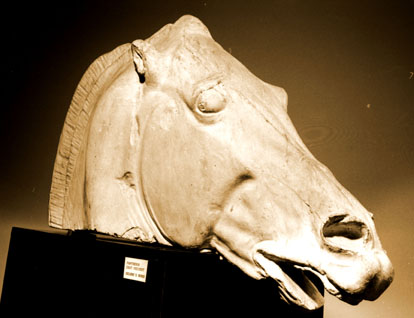
Figure O (Horse of "Selene’s" or "Nyx’s" chariot) from the East Pediment of the Parthenon. London
Head of a Horse. From the North Corner of the East Pediment of the Parthenon, dated ca.430s BC
Marble
Pedimental Figure
From the Parthenon in Athens. The statue belongs to the South Corner of the East Pediment. It was removed by Lusieri, the agent of Lord Elgin, in 1802 and was assuredly in London in 1810.
United Kingdom, London, British Museum
438/7-434/3 BC
Preservation:The head was worked separately. The marble used is full of dark streaks . It was attached to the floor of the pediment. The rest of the horse was not depicted. In the roughly picked but even bottom surface there is a dowel hole. It appears never to have been used since the head was fastened to the pediment by a cramp at the right cheek. The left portion of the top of the mane and the top of the left ear have been deliberately removed so that the head would fit under the raking cornice. The bottom surface to the left of the mouth has also been removed to enable the piece to fit against the horizontal cornice.
There is a hole at the center of the muzzle, holes behind the ears, and at the corners of the mouth for the attachment of metal decoration, bridle, and bit. There are also ten holes in the ridge of the mane for the addition of a decorative element. In 1912 there were still traces of paint in the eyes.
Description:The sculpture depicts the head of an excited horse. The bottom surface cuts through the neck in line with the bottom of the jaw.
The mane is rendered in two layers. Each layer is composed of engraved parallel lines denoting hair. The ears are pulled backwards. The cheeks are distinctly flat and defined by arcing lines that run from the ears to below the jaws and by a line (parallel to the neck) that marks the beginning of the muzzle . The eyes are convex surfaces and feature carefully articulated eyelids. The nostrils flare open and the mouth opens. The upper teeth are depicted.
Discussion:This head of a horse, Figure O, rested on the North corner of the cornice of the East Pediment of the Parthenon, in which the Birth of Athena was depicted. Its muzzle hung over the bottom cornice. Building records from the Parthenon allow us to date the sculpture of the pediments in the 430s BC and perhaps as specifically as 438/7-434/3 BC. This horse’s head was included in a drawing made by Jacques Carrey in situ in 1674. Just as many of the other sculptures from the Parthenon, the statue was removed from the pediment for Lord Elgin and is now on display at the British Museum. For more on the East Pediment of the Parthenon, see cat.nos. A 91and D 107.
This head, O, was one of four adjacent horses’ heads at the north corner of the pediment (viewer’s right). It was second from the outside edge and is the best preserved. Fragments of the other three heads are in the Acropolis Museum in Athens. These four horses’ heads represented the team driven by a female figure N. N and her horses, diving into the pediment, are the pendants to the male figure with rising horses, Helios, in the southern corner (viewer’s left) of the pediment. These two groups frame the action of the pediment. As the charioteer of the rising horses has been identified as Helios, the sun, it is likely that N represents Selene, the moon, or Nyx, night, divinities who are iconographically almost impossible to distinguish from each other. Because of the relatively large space between figure N and the horses heads, it has been suggested that waves were depicted between the Selene/Nyx and her team of horses. The intention was to frame the pediment with the sun rising over the world on one side and the Moon or Night setting, possibly into the Ocean, on the other side.
J.Lenaghan
Bibliography:A.H. Smith,
British Museum. The Sculptures of the Parthenon (London 1910)
F. Brommer,
Die Skulpturen der Parthenon Giebel. Katalog und Untersuchung (Mainz 1963) 23-24, 156-157 pls.56-60
catalogue entry with full bibliographyW. Fuchs,
"F. Brommer,Die Skulpturen der Parthenon Giebel. Katalog und Untersuchung" (Gnomon 39 1967) 165
additional comments on technical details of OE. Harrison,
"Athens and Athena in the East Pediment of the Parthenon" (AJA 71 1967) 55
barely notes 0, calls it head of horse of Selene's teamE. Berger,
Die Geburt der Athena im Ostgiebel des Parthenon (Basel 1974) 13-14
discussion of corner figures and their relevance to location in regard to Mount OlymposF. Brommer,
Die Parthenon Skulpturen-Metopen, Fries, Giebel, Kultbild (Mainz 1979) 49-50, pl.143
brief statement, best preserved head of Selene's teamB. F. Cook,
The Elgin Marbles (London 1984) pp.51-52 fig.63
brief discussion in catalogue for general publicE. Simon,
"El Nacimiento de Atenea en el Frontón Oriental del Partenón" Coloquio sobre el puteal de la Moncloa (Madrid 1986) 75
Nyx better identification for charioteer of O than SeleneO. Palagia,
The Pediments of the Parthenon (Leiden 1998) 23 figs.51-53
discussion of preservation and appearance, considers N to be Selene