Commentary Prepared by Dr. Julia Lenaghan, Ashmolean Museum
A 092
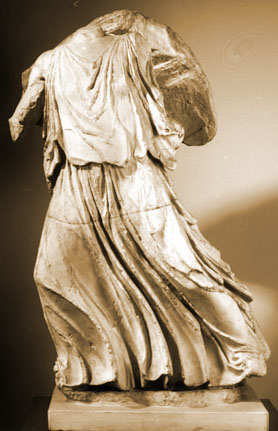
Figure G ("Artemis" or "Hekate") from the East Pediment of the Parthenon. London
Female divinity running towards her right with mantle billowing behind. From the South Corner of the East Pediment of the Parthenon, dated ca.430s BC
Marble (Pentelic)
Pedimental Figure
1.73 m with plinth
From the Parthenon in Athens. The statue belongs to the South Corner of the East Pediment. It was removed by Lusieri, the agent of Lord Elgin, in 1802 and was assuredly in London in 1810.
United Kingdom, London, British Museum
438/7-434/3 BC
Preservation:The figure is missing its head; the right forearm, wrist, and hand; the left arm (including the hand) from the shoulder down; and the front part of both feet. Portions of the outer garment have also broken off. The back side of the himation has been deliberately cut back. The bottom folds of the peplos, behind the left foot, are broken or deliberately cut back. There is a hole at each shoulder for the addition in metal of the button of the inner garment
Description:The statue depicts a woman running to her right. Although the head is missing, the break at the neck shows that the figure looked back to her left. Both legs are shown in profile, moving to the figure’s left, but the upper body faces forward. The right arm is lowered and moves to the right of the body. The left arm seems to have been raised. Both hands would have held a corner of a mantle.
The figure is barefoot and wears a sleeveless peplos. With its upper edge folded, the peplos is wrapped around the body, beginning at the left side. At the shoulders, the crease of fold in front and the crease of the fold in back are pulled up and buttoned together. The folded area (overfall) is longer at the front than at the back. In front the top edge of the peplos, folded down, crosses between the hips. At the back the upper edge of the peplos, folded down, reaches just above the waist. A belt is tied around the waist underneath overfall. Only this belt holds the horizontal edges of the peplos which converge at the left side together. The left leg pushes through these horizontal edges and bare skin is revealed from the ankle to the buttock on the left side. The figure holds between its outstretched hands a heavier garment (himation). This blows out behind the figure.
The figure is smaller in scale than other female statues from the Parthenon pediments and it appears particularly flat-chested.
Discussion:This running female divinity, known as figure G, comes from the East Pediment (depicting the Birth of Athena) of the Parthenon. Building records from the Parthenon allow us to date the sculpture of the pediments in the 430s BC and perhaps as specifically as 438/7-434/3 BC. The first modern testimony of G is a drawing made by Jacques Carrey, the artist of the French Ambassador, who saw it still in situ in 1674. Its exact placement on the pediment is known not only from Carrey’s drawing but also there is a bed or indentation to receive the plinth on the floor of the tympanum. The bedding slants so that the right portion of the figure was closer to the front edge of the pediment than the left side of the figure. The back of the himation was cut back to fit against the back wall of the pediment. Just as the other sculpture from the Parthenon, the statue was removed from the pediment for Lord Elgin in 1802. The statue is now on display at the British Museum. For more on the East Pediment of the Parthenon, see cat.nos. A 91and D 107.
The statue is called Figure G because it is the sixth statue from the viewer’s left hand corner. Immediately to the statue’s left are two seated female figures on a larger scale. These, E and F, are usually identified as Demeter and Kore. The figures to the immediate right of the Running G are not preserved. It is clear however, that G is running from and looking at the action of the center of the pediment, the birth of Athena.
It is impossible to know exactly who Figure G represented. Among the various identities proposed for the statue are Iris, Nike, Eileithyia, Kore, Aglauros, Hebe, one of the Horai, Artemis, and Hekate. Iris appears on the West Pediment where she has wings. Since G figures no wings, both the Iris and Nike identifications are weak. For Eileithyia, who aids at child birth, the figure seems too far from the center action. Aglauros would seem too insignificant a figure to appear with the most important divinities on Mount Olympos at the birth of Athena. Kore is probably better identified as figure E. Hebe seems unlikely since she does not run. The Horai possibility is unconvincing since the figure stands alone, unassociated with any two other female statues; the Horai are generally shown as a group of three. Consequently, Artemis and Hekate are generally considered the most probable solutions. If one were to use the same methodology as is used to identify Figure D (A 91) of the East Pediment as Dionysos, one ought to judge Artemis the most logical identification for G because Artemis appears on three Attic reliefs in this manner of dress and posture. Yet some scholars (Brommer, Palagia) object to Artemis because of the small-scale of the figure and because they have identified Artemis elsewhere in the pediment. Hekate is an attractive solution if Figures E and F can be surely identified as Kore and Demeter. Hekate often appears with these two divinities in vase painting. It has been noted, however, that Artemis often incorporates some of the traits of Hekate.
The style of Figure G has also been a source of discussion. It differs from all other statues of the pediment. It shows heavy broad fold patterns that function completely separately from the body and are without fussy attention to detail. Moreover, unlike other statues in the pediment, it is attached to the pediment merely through the indentation for its plinth. Some scholars have even been tempted to identify the sculptor who created the statue.
Fuchs alone associates a head, S 2094 from the Agora, with this figure.
J. Lenaghan
Bibliography:A.H. Smith,
British Museum. The Sculptures of the Parthenon (London 1910)
F. Brommer,
Die Skulpturen der Parthenon Giebel. Katalog und Untersuchung (Mainz 1963) 12-14, 153-154
catalogue entry with bibliography and discussion of previous research, considers Artemis to be the most likely identification for figure GW. Fuchs,
"F. Brommer,Die Skulpturen der Parthenon Giebel. Katalog und Untersuchung" (Gnomon 39 1967) 162-163
critique of Brommer, considers G to be Hebe, recognizes Agora S2094 as possible headE. Harrison,
"Athens and Athena in the East Pediment of the Parthenon" (AJA 71 1967) 41-42
argues that figure G represents ArtemesE. Berger,
Die Geburt der Athena im Ostgiebel des Parthenon (Basel 1974) 30-40
identifies figure G as a Hore, in the role of protector of the doors of Mount Olympos and as companion of major godsF. Brommer,
Die Parthenon Skulpturen-Metopen, Fries, Giebel, Kultbild (Mainz 1979) 47-48 pl.135
repeats that G represents ArtemisB. F. Cook,
The Elgin Marbles (London 1984) 49-50 fig.62
brief discussion in catalogue for general public, considers G to be HebeJ. Boardman,
The Parthenon and its Sculptures (London 1985)
E. Simon,
"El Nacimiento de Atenea en el Frontón Oriental del Partenón" Coloquio sobre el puteal de la Moncloa (Madrid 1986) 72-73 fig.15
G is HekateO. Palagia,
The Pediments of the Parthenon (Leiden 1998) 20-21 pls.37,39-41
discussion of appearance and identity, considers the statue to represent Hekate