Commentary Prepared by Dr. Julia Lenaghan, Ashmolean Museum
A 070
Stables of Augias (East 12); Olympia Metope
Marble (Parian)
Metope
H 160 cm
From the eastern porch of the Temple of Zeus. The main fragments were found on the floor of the east pteron of the temple, just north-east of the northern ante, and to the east of the temple. Others were built into later structures further away. The various fragments were found between 1876 and 1879.
Greece, Olympia, Olympia Museum
ca. 465-460 BC; Early Classical
Preservation:The metope was broken into numerous fragments. Most of Heracles’ torso from below the chest and a substantial part of his right leg are missing. Also broken off are his nose, a section of both arms around the elbows, and the inner part of his right foot. Athena is missing her chin with a part of the lower right side of the face, the tip of her nose, the fingers of the right hand and the tips of the toes of her left foot. Much of the relief ground on the left half of the metope around the figure of Heracles has gone. The surface is much worn and abraded, with some larger scores, especially along the breaks. Traces of colour where preserved on the helmet of Athena when the sculpture was found.
Description:Description:
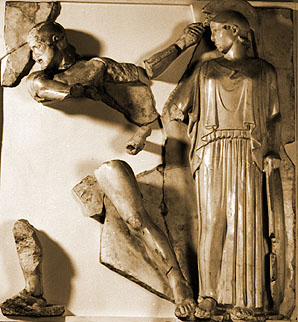
The nude, heroic figure of Heracles fills the left two thirds of the metope. He is shown in a wide stance, with the left leg set far back and the foot turned frontally, while the right leg was set slightly forward, resting firmly on the ground and seen entirely in profile. The upper part of his body is tilted in a forward movement to the right; both arms swing out far to the left, holding the shaft of a long tool that is partly preserved on the inside of the left arm. Heracles’ head with short hair and beard is turned to the right and lowered, gazing at a point on the lower left rim of the metope where the tool was pointed.
Athena is shown in a relaxed, frontal pose, clad in a girded Doric peplos with kolpos. She is standing upright with her head turned towards Heracles. Her left arm is held downwards along the side of the body, the hand rests on the rim of an oval hoplite shield that is seen in profile. Her right arm is slightly raised outwards to the right. There is a circular hole in her right hand for the attachment of an attribute. She wears an Attic helmet with a long crest; there are two large, circular dowel holes for the attachment of a separate, raised cheekpiece.
There are numerous small holes for the attachment of metal spikes against birds on both figures.
The upper side of the metope was marked on the left with a capital letter alpha, indicating the exact position of the metope above the cella.
Discussion:The metope is among the most outstanding of the Olympia cycle. From Pausanias’ description and the findspot it is apparent that it belonged to the right (northern) end of the east frieze. The theme, immediately obvious but also known from Pausanias, is Heracles’ cleaning of the Augeian stables. Originally it did not belong to the narrower cycle of his deeds, but at Olympia it was chosen for its local significance: It is by diverting the waters of the river Alpheios that Heracles succeeds in cleaning up the stables in only one day. Excellent use has been made of the confined space of the metope. Athena’s vertical figure frames the field on the right, and thereby marks the end of the entire sequence. She was pointing with a spear, added separately in bronze, to a spot on the stable wall, symbolized by the left frame of the metope. Following her directions, Heracles is shown in a dynamic diagonal, vigorously stemming a crowbar to make a hole for the water to pass through.
After the completion of this task, Heracles would proceed to mark out the Sacred Precinct and institute the Olympic Festival; hence the local myth has become the crowning conclusion of the Olympian metope cycle.
Bibliography:G. Treu,
Die Bildwerke in Stein und Thon (= Olympia III) (Berlin 1895) 147; 176-178 figs. 207-209 pls. 43.12; 44.1-2
This is the thorough original publication providing details on findspot, preservation etc.B. Ashmole and N. Yalouris,
Olympia. The Sculptures of the Temple of Zeus (London 1967) 29; 184 pls. 202-211
A valuable and richly illustrated discussion including new fragments.