Commentary Prepared by Dr. Julia Lenaghan, Ashmolean Museum
A 069
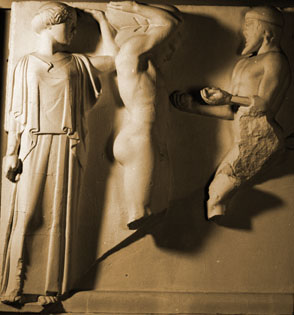
Apples of the Hesperides (East 10); Olympia Metope
Marble (Parian)
Metope
H 160 cm
From the eastern porch of the Temple of Zeus. The metope was found in 1876 where it had fallen to the ground in the eastern pteron of the temple, two steps in front of the northern column of the pronaos.
Greece, Olympia, Olympia Museum
ca. 465-460 BC; Early Classical
Preservation:The metope was broken into three main joining fragments. Missing are both of Heracles’ legs from below the knees, and most of Atlas’ legs together with the relief ground around them. A fragment of his right leg has been added (a fragment of his left shin has also been found but is not included in the cast). A small section of Atlas’ left arm between the wrist and the elbow has been restored in plaster. The surface is in good condition, slightly worn in places. The faces of all three figures are scored, the tips of the noses missing. The tips of the toes on Athena’s feet, the fingers of her right hand and a section of the arm above it, and Atlas’ left hip have broken off.
Description:The metope shows a dressed female figure seen frontally on the left side, and two nude male figures given in profile in the centre and on the right. The female figure wears a simple Doric peplos; her head is turned to the left, looking towards the central scene. The face is idealized, the hair parted in the middle and combed backwards in parallel, wavy strands. Her right arm is held downwards along the side of the body; the hand is drilled through for the addition of an attribute that also fitted in a long fold of the peplos along the right leg. Her left arm is raised, the palm of the left hand turned upwards to support an element that had been added separately in marble. The central figure is shown in the right profile. It depicts a strong, heavily built hero with short hair and beard, supporting with both raised arms the same object as the female figure next to him. In addition, the weight of this object is cushioned by a folded pillow held on his neck and head. Turned towards him is the third figure, seen in left profile; both arms are turned forward at the elbows at a right angle, the hands hold three apples each. The head shows long hair, partly taken up under a diadem that had been added separately, probably in bronze, and a full, long beard.
There are numerous small holes for the attachment of metal spikes against birds on the heads, shoulders, and arms of all figures. The upper side of the metope is marked with a capital letter gamma, to denote its exact position over the cella.
Discussion:The metope employs a simple arrangement of three parallel vertical figures to great effect. Heracles is in the centre carrying the weight of the heavens for Atlas, who has just returned from the Gardens of the Hesperides and is handing him their apples. Athena, invisible to the hero, is standing behind him and effortlessly eases his burden with her left hand, while her right must have held a spear made of a different material, probably bronze.
(Pausanias is clearly mistaken in saying that Heracles is approaching Atlas, rather than the other way around.)
Bibliography:G. Treu,
Die Bildwerke in Stein und Thon (= Olympia III) (Berlin 1895) 147; 173-175 fig. 205 pls. 50.10; 51.1-3
This is the thorough original publication providing details on findspot, preservation etc.B. Ashmole and N. Yalouris,
Olympia. The Sculptures of the Temple of Zeus (London 1967) 28; 183-184 pls. 186-193
A valuable and richly illustrated discussion including new fragments.