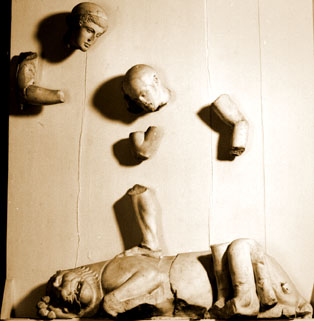
Commentary Prepared by Dr. Julia Lenaghan, Ashmolean Museum
A 066
Herakles and the Nemeian Lion (West 1); Olympia Metope
Marble (Parian)
Metope
H 160 cm
From the western porch of the Temple of Zeus. The head of Heracles was found on the north-west corner of the west pteron , most of the lion’s body 7.5 m to the west of the north-west corner of the temple. The other fragments were built into various later structures. The lion was found in 1829 and is now in Paris, the other fragments were discovered in 1879 and are in Olympia.
Greece, Olympia, Olympia Museum
ca. 465-460 BC; Early Classical
Preservation:The metope is heavily damaged, only fragments of the figures and nothing of the relief ground have survived. Best preserved is the lion, broken into two joining fragments, with only a small section of his body and paws on the left side broken off. Of Heracles only the head with the right hand, fragments of both arms around the elbows and both legs from below the knees are preserved. Both feet are partly damaged. Athena has only her head and a section of her right arm from below the shoulder to the wrist left. The left shin of a third figure is also preserved. The surface is worn, the faces of both figures are abraded (Heracles’ more so), with the tips of the noses missing.
Description:The metope originally showed a three-figure scene. A thoughtful young man with beardless face and close-cropped hair is in the centre, standing over the body of a slain lion that fills most of the bottom part of the metope. His right foot rests on the lion’s shoulder, the right arm was propped up on the right thigh, the hand supports the lowered head that is seen in left profile. The left arm is lowered and must have held a club that is partly preserved next to the lion’s body. A woman stood to the left. Her head was turned to the left towards the central figure; it shows idealized features. The hair is taken up in the back and fastened by a band that runs around the head; the forehead is framed by two rows of short curls and furrowed like the man’s. Only on the right side of the head these are fully plastically rendered. Traces of a garment are preserved on the right arm. A third figure must have stood to the right.
The lion and the legs of the central and right figure are carved fully in the round and must have been added as a separate piece of marble later, during an ancient repair.
Discussion:The metope depicts a carefully arranged three-figure scene around Heracles and the Nemeian lion. Rather than showing the actual fight, Heracles, still young and beardless, is represented in the centre over the body of the lion that he has already slain. His pensive mood reflects both the recent fight and the laborious tasks that the hero knows lie ahead. Athena stands close to him, in a similarly thoughtful mood. The third figure should have been Hermes, who is also present on metope five.
The subdued figure of the hero over the dead lion, and the vertical personifications of the deities that frame the scene, fill the confined space of the metope in a most elegantly balanced manner. This scene traditionally stands at the beginning of Heracles’ labours. From the findspot it seems certain that the metope was placed at the northern end of the west frieze. The end of the cycle is then marked by the cleaning of the Augeian stables (A 70) at the northern end of the east frieze. It is no coincidence that Heracles’ patron goddess stands next to him in both scenes.
Bibliography:G. Treu,
Die Bildwerke in Stein und Thon (= Olympia III) (Berlin 1895) 144; 153-158 figs. 175-178 pls. 35.1; 42.1-3
This is the thorough original publication providing details on findspot, preservation etc.B. Ashmole and N. Yalouris,
Olympia. The Sculptures of the Temple of Zeus (London 1967) 25 pls. 143-151
A valuable and richly illustrated discussion including new fragments.