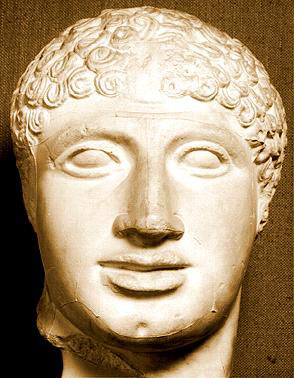
Cast Gallery catalogue number: A064
Head of a Lapith youth.
A boss of stone has been roughly removed from the hair on the forehead. Cf A045.
- Plaster cast: Height: 50cm.
- Copy of the head of a marble statue.
- The statue:
- is from the west pediment of the Temple of Zeus at Olympia.
- was made about 460 BC.
- was found at Olympia and is now in Olympia Museum.
Detailed Record
Commentary Prepared by Dr. Julia Lenaghan, Ashmolean Museum
A 064
Head of Lapith Youth (Q); Olympia West Pediment
Marble (Parian)
Pedimental Figure
H 36.5 cm
From the west pediment of the Temple of Zeus. The head was found in 1877 ca. 27.5 m to the west of the temple.
Greece, Olympia, Olympia Museum
ca. 460 BC; Early Classical
Preservation:The head is broken through the neck. The surface is slightly weathered, especially in the hair, but otherwise in good condition. A small section of the left ear including the lobe has broken off. There is a large chip on the back of the head and on the neck in front.
Description:The head is slightly lowered and turned to the right. The face, under a dense cap of hair reaching halfway down the forehead, is youthful, with full, parted lips, wide-open eyes, flared nostrils, and a furrowed forehead. The hair is rolled up in snail-curls; they are doubly incised with a circular drill hole in the centre of the curl. In front of the ears a section of hair reaches down to the lobes. There is a smooth section between the central strands of hair above the forehead. The right side of the head except for the face is only roughly picked, the right ear not indicated.
Discussion:The head belongs to the statue of a Lapith youth attacking a centaur (A 63). Substantial fragments of their bodies are preserved to give a clear impression of the action. The Lapith has locked the centaur’s head with his right arm and is forcing him down. With both hands, the centaur tries to remove the Lapith's arm and fiercely biting it. The tense features of the Lapith’s face with the parted lips and clenched teeth reveal his pain.
The smooth section of hair above the forehead may originally have been covered by the tongue of a narrow band worn around the head, that was added in a different material. However, no other traces for the attachment of such a band have survived.
Bibliography:G. Treu,
Die Bildwerke in Stein und Thon (= Olympia III) (Berlin 1895) 82-84; 111 figs. 134; 136-137 pls. 28.2; 29.2-3
This is the thorough original publication providing details on findspot, preservation etc.B. Ashmole and N. Yalouris,
Olympia. The Sculptures of the Temple of Zeus (London 1967) 19; 178 pls. 82; 86-88; 90
A valuable and richly illustrated discussion including new fragments.