Commentary Prepared by Dr. Julia Lenaghan, Ashmolean Museum
A 059
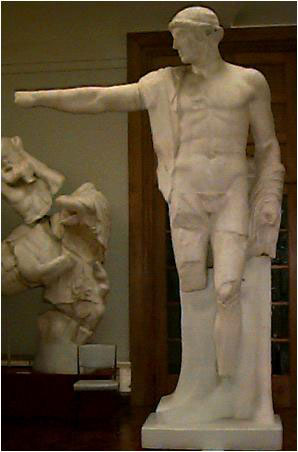
Apollo (L); Olympia West Pediment
Marble (Parian)
Pedimental Figure
H 275 cm
From the west pediment of the Temple of Zeus. The various fragments were found between 1876 and 1879 scattered over a wide area to the west of the temple, the right arm to east. Some were built into later structures.
Greece, Olympia, Olympia Museum
ca. 460 BC; Early Classical
Preservation:The statue was broken into several joining fragments (principally the torso; the head, one fragment of the right leg; three fragments of the left leg; two fragments of the right arm; several pieces of drapery). The right leg is missing from above the knee, the left leg from above the ankle. The fingers of the right hand and the membrum have broken off. Large sections of the mantle on the right side, in the back, and especially along the left leg have gone. The attribute held in the left hand is missing. A large section of the right thigh has broken off; there are substantial scores on the chest and along the breaks.
Traces of dark red paint were preserved on the mantle when the statue was found.
(Further fragments of drapery, fingers, and the heel of one foot have been found, but are not in the cast gallery.)
Description:The god is shown frontally, both legs close together. The left arm was held downwards close to the body, the right arm raised horizontally and held out to the right side, followed by a vigorous turn of the head in the same direction. The body is slim with well-defined muscles, clad only with a mantle that covers the right shoulder, falls down the back, and is then wrapped around the lower left arm from where it reaches down to the ground. (Traces of sandals are preserved on a separate foot fragment). The head shows an idealized face with full lips, and a carefully arranged coiffure. The hair falls in wavy, parallel strands; around the forehead, their ends run out in snail-curls. The ears are left uncovered. The long hair in the back is taken up and rolled under a (bronze?) ring or circlet that had been worn around the head; a wide, shallow groove above the locks over the forehead and sides, and two circular drill holes behind the ears for the attachment of this ring are preserved.
There are further dowel holes for the attachment of an attribute in and above the left hand. The entire back of the statue, as well as the right side of the head except for the locks in front of the ear, are only roughly picked; there are two large, square dowel holes in the small of the back for the attachment of iron dowels fastening the statue to the back wall of the pediment.
Discussion:The statue of Apollo stood in the very centre of the west pediment. Its original height of ca. 3.10 m gives a vivid impression of the dimensions of the temple. With an imperious gesture of his right arm, the god, an invisible apparition rather than an active combatant, orders those around him. A bow and arrow were originally added in the left hand.
The statue clearly must represent Apollo, the son of Zeus, not Peirithoos, as Pausanias mistakenly calls him.
Bibliography:G. Treu,
Die Bildwerke in Stein und Thon (= Olympia III) (Berlin 1895) 69-72; 110 figs. 110-115 pls. 27-28
This is the thorough original publication providing details on findspot, preservation etc.B. Ashmole and N. Yalouris,
Olympia. The Sculptures of the Temple of Zeus (London 1967) 17-18; 178 pls. 101-109
A valuable and richly illustrated discussion including new fragments.