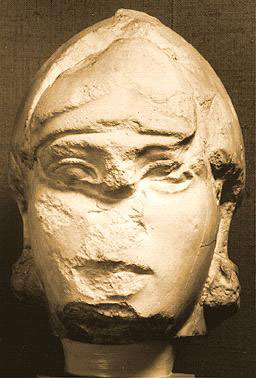
Commentary Prepared by Dr. Julia Lenaghan, Ashmolean Museum
A 047
Head of Peplops (G); Olympia East Pediment
Marble (Parian)
Pedimental Figure
H 40 cm
From the east pediment of the Temple of Zeus. The two fragments of the head were found built into later structures 10.5 m to the north and 35.5 m to the north-east of the north-east corner of the temple in 1877.
Greece, Olympia, Olympia Museum
ca. 460 BC; Early Classical
Preservation:The head consists of two joining fragments. It is broken through the neck just below the lower rim of the helmet, where it joins break to break with the (equally preserved) body. The surface of the head is mostly intact (though slightly worn and scored in places) except for the much battered face. The chin has broken off, nose and mouth are much abraded and almost completely gone. A large section of the face, including most of both eyes, the upper bridge of the nose, and the forehead with the frontal part of the cranium has broken off but can be joined with the larger fragment. There are wide chips all along the break.
The crest of the helmet has almost completely gone, both cheek pieces are missing.
Description:The head was originally slightly lowered and turned to the right, with a full, youthful and beardless face. It wears an Attic helmet that reaches down to the nape of the neck but leaves the face unprotected. There are several circular drill holes of varying diameter in the helmet and along the temples.
Discussion:The head belongs to a youthful hero (figure G) from the east pediment. Enough fragments of the body are preserved to reconstruct a figure considerably taller than life-size that must have stood close to the centre of the pediment.
The figure stood relaxed, carrying a round hoplite shield on the left arm, while the right arm was raised and held a spear. The statue was originally nude except for the helmet. The youthful appearance of the hero, especially the beardless face, suggest an identification as Pelops, clearly set off from his adversary, the older king Oinomaos.
Several drill holes on the otherwise fully worked and on the upper right thigh suggest that at a later period a cuirass of different material was added. It is likely that then also a separate helmet of a different material was put on the head, which would account for the various drill holes to be found there. Treu’s explanation of the drill holes along the temples as necessary for the attachment of downward pointing marble cheek pieces (of which he identifies a small fragment) is not very satisfying, as they could easily have been carved out of the same piece of marble. The reason for these alterations is unknown; they may have occurred when general repairs were necessary on the pedimental sculptures, or reflect changes in taste, when the original sculptures were considered too plain.
Bibliography:G. Treu,
Die Bildwerke in Stein und Thon (= Olympia III) (Berlin 1895) 46-49; 104 figs. 56-61 pls. 9.2; 11.1
This is the thorough original publication providing details on findspot, preservation etc.B. Ashmole and N. Yalouris,
Olympia. The Sculptures of the Temple of Zeus (London 1967) 13; 173 pls. 46-47; 49
A valuable and richly illustrated discussion including new fragments.