Commentary Prepared by Dr. Julia Lenaghan, Ashmolean Museum
A 029
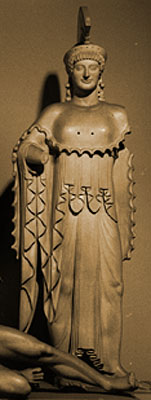
Athena from the West Pediment of the Temple of Aphaia at Aegina. Munich
Marble
Pedimental Figure
H 1.68 m
From Aigina. Found in front of the west side of the Temple of Aphaia.
Germany, Munich, Glyptothek, 74
ca. 490-480 BC
Preservation:The statue is missing the left arm, most of the shield held on the left arm, the right hand, and some of the right forearm. The nose has been restored. The feet and a piece of the plinth were found broken from the rest of the body. Traces of color were originally noticed on the bottom hem of the peplos and on the helmet.
Description:The statue depicts a draped female who wears a helmet and an aegis. The figure stands with its weight on the right leg which turns inward. The left leg is also turned in this direction. The left foot points to the left. The lowered right arm pulls slightly to the right and bends at the elbow so that the forearm moves toward and in front of the body. The left arm, which is not preserved, was probably lowered and bent.
The figure wears two garments. The finer inner garment (chiton), rendered in tightly placed wavy folds is visible only under the left arm. The upper portion of the heavier outer garment or peplos is folded over at the top. The crease of this fold serves as the upper edge. The upper border wraps around the body diagonally, passing under the left armpit and fastening at the right shoulder and down the right upper arm. The bottom border of the folded area (apoptygma) crosses roughly at the waist and features three vertical pleats which end in stylized omega folds and swallow-tails. Because of the diagonal wrap of the garment more material hangs on the right side and over the right harm. On the right the apoptygma reaches below the knees.
Below the apoptygma the material of the peplos hangs in vertical folds between the legs. Around the legs themselves the fold patterns curve adapting to the movement and shape of the legs. The bottom hem, however, which touches the ankles, is marked by a central rise that is flanked by symmetrically arranged stacks of folds. Below the feet the soles of the sandals are visible; the straps are not.
Over the shoulders the peplos is covered by an aegis that covers the breasts at the front of the body and extends down the back until just above the knees. The entire border of the aegis is scalloped and features holes on two sides of the scalloping. The scallops represent snake bodies which would have been completed by separately worked pieces attached at the holes. Between the breasts the aegis features another two holes; these were for the insertion of the Gorgon’s head. Above the breast and between the neck and the shoulder are three holes on each side for the insertion of locks of hair. Both the peplos and the aegis, especially at the back, cling to the body and reveal the female form below.
The helmetted head of the statue faces directly forward. The face has a rectangular shape since the brow is low and broad, the cheekbones wide set, and the lower portion of the face full. The eyebrows have a high arch. Between the eyebrow and the arched upper lid there is a large space. The lower eyelid is almost straight. Below the eyes the cheeks project as if they were two separate round objects. The mouth has a slight smile which is the result of its upturned corners tucked into the full cheeks. The lower lip is full and round. The upper lip is slightly shorter and has a central dip. The chin, like the cheeks, appears as a projecting round object.
The long hair in crimped horizontal waves which drop down at the temples but then loop up over the ears. The ears are completely uncovered and the lobes have holes for separately wrought earrings. Escaping from behind the ear and extending forward on the aegis were separately attached locks. Not only are holes visible on the aegis (mentioned above) but also a vertical row exists below the ears. Two horizontal rows of holes, one just at the back of the base of the neck and another across the shoulder blades, show that separately worked locks were also added at the back of the head.
On top of the head is a helmet with a central crest, a front visor, and a guard on the nape of the neck. The helmet and visor are covered with holes used for metal attachments.
Discussion:There are vestiges of sculptural decoration in Parian marble from four separate pediments in the Sanctuary of the Aphaia on the island of Aigina. These four pediments can be placed within at most a thirty year time frame, 500-470 BC. This chronological period occurs after a serious fire destroyed the Temple around the turn of the sixth century BC. Until recently it was thought that the fire occurred earlier and that all four pediments might be dated earlier. Study of the pottery from the foundation trenches has been shown to be inconclusive and some historic considerations as well as the style of the sculpture suggest a later date.
The pottery found in the foundation trenches certainly cannot be dated specifically. It, thus, proves neither that the fire and pediments dated between 525-490 nor that they dated between 500-470 BC. It could, in fact, be used to support either argument.
Historically the Aiginetans were in position to embark on a large expensive sculptural project in the middle of the 490s and had reason to trumpet their history and their heros (the Aikiadai) after the late 490s. According to Herodotos, the Aiginetans were asked by Thebes to supply aid in the Theban battle against Athens. The Aiginetans sent statues of their heros the Aikiadai; these failed to ensure a victory for Thebes over Athens. Eventually the Aiginetans themselves entered into conflict with the Athenians and notably destroyed Phaleron. D. Williams suggests that the Aiginetan raids occurred in the 490s and were perhaps the reason that the Athenians deserted the Ionians in 498/97 BC and that Themistokles fortified the Pireaus in 493/492.
Sculpturally the pediments, especially the final East Pediment, are advanced and compare well with monuments on the Parthenon erected shortly before and shortly after the Persian destruction. The sculpture from the early pediments and the final West Pediment have also been compared to the pediments from Temple of Apollo at Eretria which cannot be dated before the first decade of the fifth century.
It has, therefore, been surmised that after a fire, ca. 500 BC, had destroyed the Temple of Aphaia the Aiginetans began to rebuild the temple and designed two new pediments which showed an Amazonomachy and the Rape of the Nymph Aigina by Zeus. These pediments especially that on the East side were virtually finished in the middle to late 490s when the successful Aiginetans found themselves with war loot and a desire to assert the importance and true nationality of their heroes. A. Stewart has even proposed that the Aiginetans waited until even after 480 BC to redo the pediments. In 480 BC they would likewise have just come off a military success, the battle at Salamis, and equally be wishing to assert their importance over Athens.
In either case, it is certain that the Aiginetans decided to change the stories of the still not entirely finished pediments, replacing them with scenes from the First and Second Trojan War. The first Trojan War featured Herakles and Telamon, the chief hero of Aigina, the father of Ajax and the son of Aiakos. Aiakos himself was the son of Zeus and the nymph Aigina.. The second Trojan War scene featured Ajax, the son of Telamon and member the historic lineage of the island. It seems likely that the Aiginetans embarked on the west pediment, that of the back side of the temple, first since the previous east (front) pediment would have been more complete than that of the west pediment. They moved what had been completed of the previous west pediment into a portico in front of the temple and began the scene of the second Trojan War on the west side, probably in the late 490s (if not later). When this was completed, perhaps a decade later, they moved the sculpture of the original east pediment also into a portico and began the scene of the First Trojan War. This they likely finished in the late 480s.
The modern history of the sculpture from the pediments is equally complicated. Most of the sculpture was discovered in 1811 by a group which was led by two architects the English Charles Robert Cockerell and the German Carl Haller von Hallerstein. Their finds, though initially intended for the British Museum, were bought by Prince Ludwig of Bavaria in 1813. They were then entrusted to B. Thorvaldsen for restoration. Thorvaldsen worked on them between 1816 and 1818 in his studio in Rome. In 1828 they were displayed in the new Glyptothek in Munich. Under 100 years later, A. Furtwangler, the director of the Munich Glyptothek, campaigned to remove the Thorvaldsen restorations and began his own excavation at Aigina. The new finds, which were given to the National Museum in Athens, and further study led Furtwangler to propose an entirely new reconstruction of the pediments. In 1962, well after World War II and the bombing of Munich, the sculpture was presented in a new display organized by D. Ohly. Five years later Ohly opened his own excavations at the Temple of Aphaia in Aigina; these led to further insights. Yet Ohly’s death in 1978 has hindered the publication of many of his finding. Only his work on the East Pediment is completely published.
The statue of Athena under discussion here inarguably formed the central figure of the West pediment. She presides over the scene from the second Trojan War. The statue’s flat stylized drapery, the face which can be divided into separate zones (cheeks, chin, brow, nose), the horizontal bands of hair across the brow, and the few independent locks that fall in front of the shoulders are all aspects of late Archaic style. They recall similar features visible on the korai of the Akropolis which were erected before 480 BC.
Furtwängler claimed that the left arm and shield which initially had been thought to belong to this statue and which had in fact been restored on to this statue belonged to yet another statue of Athena. The left arm and shield have not, however, been removed from the figure in Munich. Thus, it is not clear to me whether Furtwängler was correct or not. In addition, Furtwängler found eight fragments from the edge of the aegis as well as fragments of small marble snakes that must have come from the aegis.
Ohly considered the figure directly to the right of Athena to be Ajax because of the eagle painted on his shield. The eagle, according to Pindar, had been sent by Zeus as a sign to Telamon that Telamon would have a son. Other scholars have found this supposed proximity of Ajax and Athena difficult to believe given their relationship in Homer’s Iliad. If, however, Ohly were correct, we might expect that this does not bother the Aiginetans and that they may have had their own local myths.
Bibliography:A. Furtwängler,
Beschreibung der Glyptothek König Ludwig's I zu München (Munich 1900) pp.90-94 no.74
catalogue entry that accepts the left arm restored by Thorvaldsen as in part originalA. Furtwängler,
Aigina. Die Heiligtum der Aphaia (Munich 1906) pp.215-216 no.G pl.96
rejects the pertinence of the left armD. Ohly,
Glyptothek Munchen: Griechische und romische Skulpturen (Munich 1972) pp.62-63
discusses arrangement of the figures of the West PedimentD. Williams,
"Aegina, Aphaia-Temple" (AA 1987) pp.669-674
suggests new slightly later date for the pediments based on pottery finds and historic eventsA. Stewart,
Greek Sculpture. An Exploration (New Haven 1990) pp.137-138
dates the inception of the final pediments of the Temple to after 480 BCH. Knell,
Mythos und Polis (Darmstadt 1990) pp.68-78
discussion of the Temple of Aphaia at Aigina, particular empahsis on the pediments