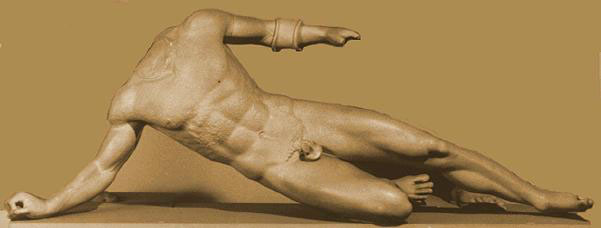
Fallen warrior. He once had a shield on his left arm and a weapon, probably a sword, in his right hand.
Commentary Prepared by Dr. Julia Lenaghan, Ashmolean Museum
A 028
Wounded Warrior from the West Pediment of the Temple of Aphaia at Aigina. Munich
Marble (Parian)
Pedimental Figure
Length 1.44 m, Height 0.63 m
From Aigina. Found at the Temple of Aphaia, in the front of the west side near the northern end.
Germany, Munich, Glyptothek, 75
ca. 490-480 BC
Preservation:The statue is missing its head, throat, shield, fingers, and toes. The area around the right breast is seriously eroded and was restored. Thorvaldsen restored all of these parts. The head, which he attached, was actually thought until 1906 to belong to the body. All of Thorvaldsen’s restorations have been removed from the statue in Munich. Yet in the Ashmolean cast, the restored fingers, toes, and right breast area are still visible. There are holes in the left breast area where there was once a metal attachment.
Description:The statue depicts an under life-size naked male who, fallen to the ground and lying on this right side, strains upward. The right arm, slightly less than perpendicular to the ground, supports the upper body. From the right armpit to the right knee the right side of the body slants at a 45 degree angle and avoids touching the ground. The left arm is held up away from the body and parallel to the ground. It bends slightly. Below the elbow it wears a broad band with raised edges that was attached to the no longer extant shield. The outer side of the arm from the band down is flat since it was contiguous to the shield. On the left side of the rib cage and the left breast are three holes. These presumably served to attach a sword belt.
The tensed left leg is almost fully extended and lies over the more pronouncedly bent right leg. The left foot, the heel of which touches the ground, is perpendicular to the leg and points outward toward the viewer. The right leg of the figure is bent at a 45 degree angle. The upper leg comes forward and the lower leg goes backward. The outer side of the entire lower right leg and a portion just above the knee is in contact with the ground. The foot lies naturally at a 90 degree angle from the leg and its outer side also touches the ground.
The anatomical details of the figure are carefully articulated. The musculature is fully defined, especially in the tensed left leg and the upwardly turned abdominal region. Long veins are also realistically illustrated in the arms. In addition, the scrotum shifts and presses naturally against the inner side of the right leg. Only the pubic hair is inorganically depicted. It is shown as a diamond shape which is broader than it is tall. The hairs themselves are rendered as a series of snail curls.
Discussion:A brief history, both ancient and modern, of the pedimental sculpture of the Temple of Aphaia at Aigina precedes the discussion of the central figure of Athena from the West Pediment; see cat. A 29. The figure of the fallen warrior, in discussion here, certainly belongs to the West Pediment which depicted the second Trojan War. It was found in front of the west end of the Temple and it resembles the other statues from this pediment.
The restoration of the statue and its position in the original pediment have created some problems. Thorvaldsen attached an original head (cat. A 30) to the statue. Furtwängler, however, showed that this head did not really belong and it has been since removed. It remains questionable whether the head of the figure actually looked upward, to its left, at its opponent or looked downward, to it right, at the ground. Furtwängler thought that it must look upwards but Ohly more recently has reconstructed in his drawings as looking downward.
Despite the fact that the original reports located the findspot of the statue on the north (left) side of the west front, the statue was placed in both Cockerell’s and Furtwängler’s reconstructions just to the left of center. The first reconstruction at the Glyptothek (shown in the Ashmolean casts) placed the figure directly to the left of the central Athena; its feet lay directly in front of the feet of Athena. Furtwängler moved the figure slightly further leftward in the pediment. He placed the figure between and below the two fighting warriors grouped directly to the left of Athena. In the most recent reconstruction, that of D. Ohly, which is generally accepted as the most correct, the figure is the second figure from the left corner.
Bibliography:A. Furtwängler,
Beschreibung der Glyptothek König Ludwig's I zu München (Munich 1900) pp.94-96 no.75
catalogue entry that accepts the head and places to the right of the central AthenaA. Furtwängler,
Aigina. Die Heiligtum der Aphaia (Munich 1906) pp.212-213 no.E pl.96
rejects head, but believes head would have looked up and notes that originally said to have been found at north corner of west sideD. Ohly,
Glyptothek Munchen: Griechische und romische Skulpturen (Munich 1972) p.63 no.XIII
Locates statue at the corner of the pediment and reconstructs it with a downward glance