Commentary Prepared by Dr. Julia Lenaghan, Ashmolean Museum
A 022
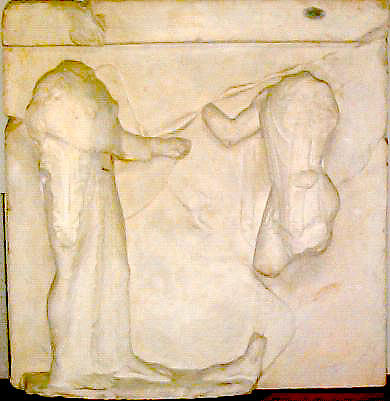
Theseus and Athena (Metope 5); Athenian Treasury, Delphi
Marble (Parian)
Metope
H 67 cm
From the Athenian Treasury at Delphi. The various fragments were found in 1893 in a modern house above the treasury, and on the surface of the Holy Way to the south.
Greece, Delphi, Museum, 70+1496
Late Archaic, after 490 BC
Preservation:The metope consists of several joining fragments. The lower right corner and a large portion of the relief ground around it have gone. The head and right arm of Athena are missing. The head, left arm, right hand, entire left leg and a section of the right leg of Theseus have broken off. The surface is scored and abraded.
Description:The metope shows a male and a female figure facing each other in three-quarter profile. They both stand with the leg closest to the relief ground advanced and the weight evenly distributed. The female figure on the left is clad with a thin chiton reaching down to her feet, a short mantle, and an aegis draped over her shoulders and the extended left arm. There are several circular drill holes along the rim of the aegis for the attachment of metal attributes, a square socket below, and a dowel hole on the right flank. She is considerably taller than the male figure and her head extended well beyond the upper frame of the metope. The man is approaching her from the right. He wears a short, almost transparent chiton and a chlamys, and has raised his right arm in a gesture of greeting.
Discussion:The two figures represent Theseus and his divine patron, the goddess Athena. This is the only metope whose original position in the frieze can be determined with some precision. Because Athena was so tall that she extended beyond the upper frame of the metope, the geison above had to be worked off accordingly. Traces of that intervention are preserved in the middle of the south wall. The metope therefore formed the centre of the Theseus episodes depicted there. A calm contrast in the vertical positioning of the figures to the dramatic scenes depicted around, it probably divided the events not connected to Athens itself on the left from the Athenian episodes on the right of the metope frieze. See also A 20-21; 23.
Bibliography:J. Audiat,
"Le Tresor des Atheniens" (FdD II 1933)
Gives a full account of the architecture and reconstruction of the treasury.P. de la Coste-Messeliere,
"Sculptures du Tresor des Atheniens" (FdD IV 4 1957) 51-58 pls. 15-18
The thorough original publication of the sculptures. The Theseus metopes are reconstructed on the south and east sides, the Heracles metopes on the west and north. Following Pausanias a date after 490 BC is proposed.K. Hoffelner,
"Die Metopen des Athener-Schatzhauses. Ein neuer Rekonstruktionsversuch" (AM 103 1988) 77-115 foldout 5 (esp. 83-84 fig. 5
Provides a detailed description of the metopes. H. argues for a date before 490 BC and offers a different reconstruction (Theseus metopes on south and north, Heracles metopes on the east and west sides; some 'Heraclesmetopes' are ascribed to Theseus.H. Knell,
Mythos und Polis (Darmstadt 1990) 52-63
Is a comprehensive account of the sculptural decoration and the chronological arguments.