Cast Gallery catalogue number: A017
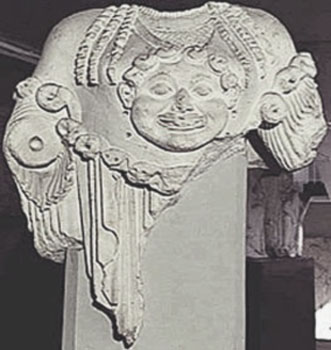
Athena wearing an aigis decorated with a large head of Gorgo.
- Plaster cast: Height: 78cm.
- Copy of a marble statue.
- The statue:
- is from the west pediment of the Temple of Apollo Daphnephoros at Eretria.
- was made about 510 BC.
- was found at Eretria and is now in Chalkis, Archaeological Museum.
Detailed Record
Commentary Prepared by Dr. Julia Lenaghan, Ashmolean Museum
A 017
Athena; Eretria West Pediment
Marble (Parian)
Pedimental Figure
H 74 cm
From the Temple of Apollo Daphnephoros in Eretria. Found to the west of the temple in 1899.
Greece, Chalkis, Chalkis Museum
ca. 510-490 BC; Late Archaic
Preservation:Preserved is the upper half of the torso from the neck to just below the chest. The head and both arms from above the elbows are missing. On the left side a longer section of the himation remains.
Description:The fragment belongs to a richly draped female statue. She wears a thin chiton visible around the neck and on the arms, a himation, and an aegis with a large gorgoneion over her chest. Along the break on the neck remains of a fine necklace are visible. Three separate tresses of long hair reach down the chest over both shoulders. The left arm must have been held slightly away from the body, the right arm was bent in the elbow and held forward.
There are four circular drill holes around the gorgoneion for the attachment of metal ornaments. The back of the statue is flat and only roughly picked, with a large, square dowel hole in the centre.
Discussion:The torso belongs to a statue of Athena, recognizable by her aegis, from the west pediment of the Temple of Apollo Daphnephoros in Eretria. The temple seems to have been built at around 510
B. C. and was destroyed by the invading Persians in 490 B. C. (cf. Herodotos 6.101). Only the decoration of the west pediment can be reconstructed. It depicted an Amazonomachy with Athena in the centre, flanked by two chariots and various battle groups. Topic and style link the pediment to works from Athens, a close ally of Eretria in these years. The sculptures of the temple have been attributed to the workshop of the sculptor Antenor.
Whereas the composition of the pedimental groups is still in the Archaic fashion, the individual sculptures are well advanced. The next stage of the development is exemplified by the sculptures from the Temple of Aphaia on Aegina (A 28-42).
See also A 18.
Bibliography:K. Kourouniotes,
"Anaskaphai en Eretria" (Praktika 1900) 53-56
A brief first notice about the finds from the temple.A. Stewart,
"Aristion" (AAA 9 1976) 257-267
Discusses several sculptures attributed to Aristion from Paros, among them the pedimental sculptures from Eretria.E. Touloupa,
Ta Enaetia Glypta tou Naou Apollonos Daphnephorou sten Eretria (Ioannina 1983)
Detailed study of the pedimental sculptures, including newly attributed pieces and a reconstruction (in modern Greek).E. Touloupa,
"Die Giebelskulpturen des Apollon Daphnephorostempels in Eretria" (Archaische und Klassische griechische Plastik I 1986) 143-151 pls. 59-65 lose plate 2
A summary of the previous in German.H. Knell,
Mythos und Polis (Darmstadt 1990) 64-67
A brief synopsis of the architecture and sculptural decoration of the temple.